Define what matters
Connect the product, measurement range, operating conditions, and acceptance criteria before selecting the test hardware.

Rocavo / Engineering services
Mechanical fixtures, instrumented test stands, and test stations designed around what you need to measure and how the test will run.
The Rocavo AI Engine ↗In development to connect requirements, design, and verification.
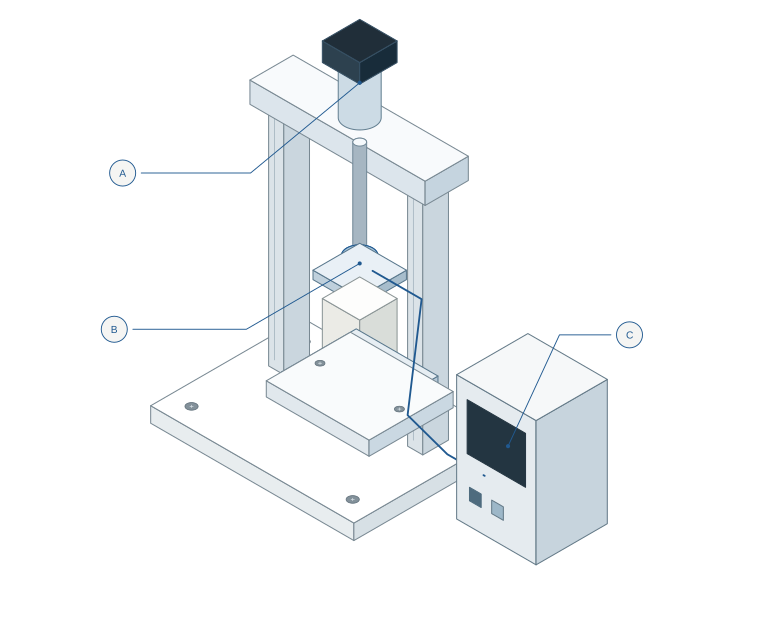
01 / The work
A useful test depends on more than selecting an instrument. The product must be held consistently, connected correctly, operated through a defined sequence, and measured against clear acceptance criteria.
Define locating, clamping, alignment, and electrical or fluid interfaces around the product under test and its handling requirements.
Coordinate instruments, sensors, loads or motion, data interfaces, and the sequence needed to produce useful measurements.
Develop the operator workflow, setup instructions, changeover provisions, and checks needed for an agreed test process.
02 / The Rocavo AI Engine
Fixture mechanics, sensing, wiring, control logic, and data handling all shape a test. The Rocavo AI Engine is being developed to coordinate them around a shared definition of what the system must measure and demonstrate.
Connect the product, measurement range, operating conditions, and acceptance criteria before selecting the test hardware.
Consider alignment, applied loads, instrument connections, operator actions, and software interfaces together.
Identify the checks, calibration needs, and physical trials required to evaluate the station against the agreed requirements.
Our internal engineering platform is in active development. Every customer engagement has an agreed scope, review stages, deliverables, and acceptance criteria.
Explore the Engine’s approach ↗03 / Your engineering package
The proposal identifies exactly what you receive. The following elements can be combined into a focused assignment or a broader system engagement.
A defined unit under test, measurements, operating conditions, sequence, and acceptance criteria, with unresolved requirements identified for review.
Models and drawings for the agreed mechanical scope, including locating features, interfaces, access, and assembly details.
Selected instrumentation, connection details, control architecture, and data or software interfaces where required by the test and included in the scope.
A bill of materials, operating or setup instructions, and an agreed verification plan. Physical test execution and results are included when commissioned as part of the engagement.
Design package or complete system: we agree the responsibility for procurement, fabrication, assembly, integration, and physical testing before work begins. File formats, review stages, price, and schedule are part of that scope.
04 / How an engagement starts
Bring what you have. We can identify the missing decisions together before detailed work begins.
Tell us what is being tested, which measurements matter, and how the setup will be used. Include available product drawings and your current test procedure.
Define deliverables, responsibilities, review points, acceptance criteria, timing, and price. A first phase can resolve feasibility or requirements.
Review the design at agreed stages, resolve feedback, and prepare the contracted engineering package or system handoff.
Before you begin
Start with the product or its drawings, what you need to measure, and any existing test procedure. Accuracy, applied loads, cycle time, utilities, operator steps, and pass/fail criteria help establish the design. We can help clarify requirements that are still open.
We can assess that as part of scoping. Share the equipment models, interfaces, software environment, and any constraints on changes. Compatibility and integration responsibilities are agreed before the design proceeds.
Either may be scoped. An engineering package defines what your team or supplier will build; a system-delivery engagement also assigns responsibility for procurement, assembly, integration, and agreed acceptance testing.
Start with your requirements
Tell us what is being tested, which measurements matter, and how the setup will be used. Include available product drawings and your current test procedure.
Send your requirements