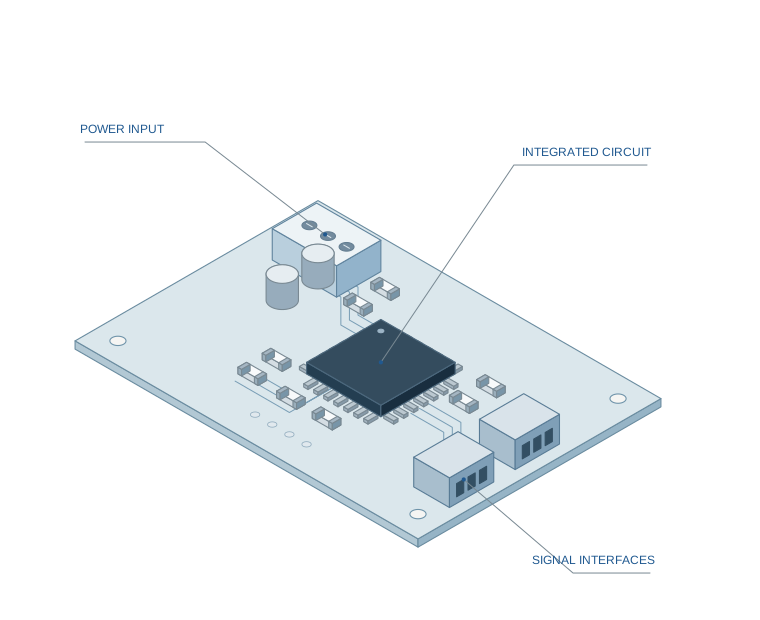
Develop the circuits, boards, power distribution, and connections your hardware needs. Bring a new product, an existing schematic, or an electrical subsystem that needs to fit into a larger machine.
Architecture, circuits and physical connections.Illustrative concept
01 / Engineering capabilities
Specific work. A connected perspective.
Electrical design connects a product’s function to its physical implementation. Signal levels, power, interfaces, packaging, and the operating environment shape what belongs on the board and how it connects to the system.
01
Circuit architecture & PCB design
Translate functional requirements into a circuit architecture, schematics, and board layout. Resolve board outline, mounting, connector access, layer requirements, and fabrication constraints with the mechanical design.
Typical scope outputsBlock diagrams and schematics · PCB layout and fabrication outputs · Assembly information
02
Analog & mixed-signal circuits
Define signal conditioning for measurement and control: amplification, attenuation, filtering, conversion, and reference circuits. Establish the signal range, bandwidth, noise, and accuracy assumptions before selecting the circuit approach.
Typical scope outputsSignal-chain design · Error and noise estimates · Component and layout requirements
03
Power & component selection
Develop power budgets, supply rails, distribution, and component selections around operating and startup loads. Consider thermal dissipation, protection, availability, and the interfaces between power supplies, boards, and purchased equipment.
Typical scope outputsPower budget · Power and protection schematics · Component selection rationale
04
Sensors & data acquisition
Connect physical measurements to usable electrical data. Select the sensor interface, excitation, conditioning, sampling, and acquisition architecture around measurement range, timing, calibration needs, and the software consuming the data.
Define how boards, instruments, actuators, and enclosures connect. Coordinate pin assignments, connector selection, cable routing, shielding, grounding, and service access with the mechanical and controls design.
Typical scope outputsPinouts and connection schedules · Cable or harness drawings · Wiring documentation
06
Board bring-up & verification planning
Plan the first checks before hardware is powered. Identify test points, power-up order, expected readings, equipment, calibration steps, and fault-isolation methods, with measurements tied to the design requirements.
These example requests show how a project can begin. They describe possible scopes, not completed customer projects.
01 / EXAMPLE BRIEF
Turn a breadboard into a board
Develop a documented circuit and PCB from a working prototype, with defined interfaces, mounting, component selections, and files for an assembly supplier.
02 / EXAMPLE BRIEF
Resolve a measurement interface
Define the electronics between a sensor and your acquisition system, including signal conditioning, conversion, calibration provisions, and the measurement limits to verify.
03 / EXAMPLE BRIEF
Complete an electrical subsystem
Bring an existing design’s power, boards, instruments, connectors, and wiring into a coordinated package that a builder can review and assemble.
03 / The Rocavo AI Engine
The circuit belongs to the system.
We’re developing the Rocavo AI Engine to connect electrical decisions with mechanical packaging, firmware, controls, and system requirements. A changed signal, supply, or connector can affect several engineering outputs.
01 / CONNECTED ENGINEERING
Define the interfaces
Connect signal ranges, timing, power, mounting, and environmental requirements before committing to component and layout decisions.
02 / CONNECTED ENGINEERING
Follow a change
Review how a revised sensor or load affects conditioning, power, connectors, packaging, software interfaces, and verification.
03 / CONNECTED ENGINEERING
Coordinate the package
Keep schematics, board files, wiring, component selections, and planned checks aligned with the same design revision.
The Engine is Rocavo’s internal platform, in active development. Your engagement has an agreed scope, engineering review points, deliverables and acceptance criteria.
We define the deliverables around the work you need. A focused assignment may use only part of this package; a larger engagement can connect it to the other disciplines.
Electrical design basis
Requirements, architecture, interface definitions, operating assumptions, calculations, and unresolved decisions that establish what the design must achieve.
Design and manufacturing files
Agreed schematic and PCB source files, fabrication and assembly outputs, connection drawings, and mechanical interface information, in formats identified before work begins.
Components and build information
A bill of materials, component specifications, connector and cable schedules, and assembly notes appropriate to the electrical package.
Verification and handoff
A bring-up and verification plan with acceptance criteria. Prototype procurement, assembly, physical testing, and resulting test reports are included when explicitly commissioned.
We agree file formats, source access, review stages, schedule and acceptance before work starts. Procurement, physical builds, commissioning, specialist reviews and ongoing support are identified separately where needed.
Before you begin
Useful questions.
Can you work from an existing circuit or PCB?
Yes. Share the available source files, BOM, known problems, and required changes. We’ll review what can be reused and identify missing information before defining the work.
Can a project cover electronics and the enclosure?
Yes. Board outline, mounting, connectors, cable access, cooling, and enclosure geometry can be developed together as a combined electrical and mechanical assignment.
How does this differ from controls engineering?
This service focuses on electrical hardware, circuits, measurement interfaces, and connections. Controls engineering covers machine behavior, PLC and HMI logic, device coordination, and operating sequences. A project can include both.
A focused task or a larger system
Where does your project need help?
Share the required functions, signal and power levels, existing schematics or prototypes, enclosure constraints, and connected equipment. Include the intended environment and any required design or file-format standards.