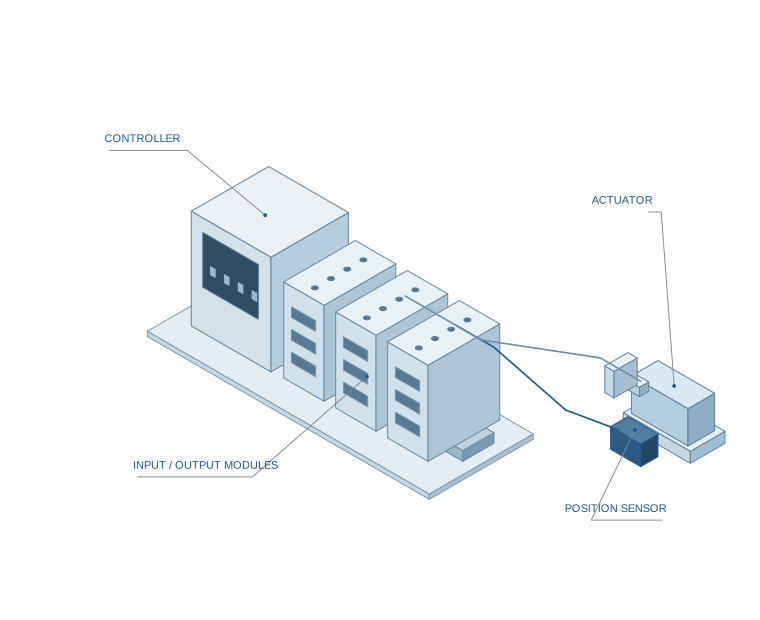
Define how a machine starts, moves, measures, responds, and stops. Develop the control architecture, PLC or software logic, operator interface, and device connections around the process your equipment must perform.
The sequence, the signals and the equipment.Illustrative concept
01 / Engineering capabilities
Specific work. A connected perspective.
Controls turn individual components into a coordinated machine. The work starts with operating states, interfaces, operator actions and expected behavior, then defines the inputs, outputs and logic needed to implement it.
01
PLC logic & operating sequences
Define automatic and manual modes, startup conditions, sequencing, permissives, interruptions, and recovery. Connect each operating state to the relevant inputs, outputs, timing, and feedback before developing the agreed logic.
Typical scope outputsSequence and state definitions · I/O mapping · PLC source and configuration
02
HMI & operator workflow
Develop screens around the tasks an operator must complete: setup, operation, changeover, alarm response, and maintenance. Define displayed values, editable settings, access levels, and clear machine status.
Typical scope outputsScreen flows and layouts · Tag and parameter definitions · HMI project files
03
Motion & actuator coordination
Coordinate axes, drives, conveyors, valves, and other actuators with the process sequence. Define homing, position or velocity commands, travel limits, completion feedback, and the conditions for interrupting or resuming motion.
Typical scope outputsMotion sequence definition · Drive and controller interfaces · Parameter and limit schedules
04
Instrument & device communications
Connect controllers with instruments, sensors, drives, and other equipment. Establish the supported protocols, data mapping, update rates, timeouts, and recovery behavior needed for dependable information exchange.
Typical scope outputsCommunication architecture · Register or message mapping · Integration code and settings
05
Data logging, recipes & records
Define which settings and measurements must be stored, when they are captured, and how they relate to a part or test. Coordinate recipe selection, parameter limits, timestamps, result records, and export formats.
Typical scope outputsRecipe and data definitions · Logging and export functions · Storage and retention requirements
06
Commissioning & fault-test planning
Prepare checks for I/O, device communication, sequence transitions, alarms, and recovery. Include interrupted cycles, missing feedback, communication loss, and restart conditions so normal operation is only one part of acceptance.
Typical scope outputsCommissioning procedures · Normal and fault test cases · Acceptance and issue records
02 / Ways to put it to work
Bring a real engineering problem.
These example requests show how a project can begin. They describe possible scopes, not completed customer projects.
01 / EXAMPLE BRIEF
Define the controls for a new machine
Turn a mechanical concept and process description into a control architecture, operating sequence, I/O definition, operator workflow, and implementable controls scope.
02 / EXAMPLE BRIEF
Connect a test station’s equipment
Coordinate instruments, actuators, and software so the station follows a defined test sequence and produces records linked to the correct product and settings.
03 / EXAMPLE BRIEF
Revise an existing sequence
Assess a change in process, motion, sensing, or operator workflow, then identify the affected logic, HMI screens, interfaces, documentation, and acceptance checks.
03 / The Rocavo AI Engine
A sequence connects the whole machine.
The Rocavo AI Engine is in development to connect control behavior with hardware, interfaces, and requirements. A mechanical or process change can alter the sequence, sensing, operator workflow, and acceptance plan.
01 / CONNECTED ENGINEERING
Describe the behavior
Link required outcomes to operating states, device actions, operator decisions, and the feedback that confirms each step.
02 / CONNECTED ENGINEERING
Review connected changes
Follow a new actuator, sensor, or process step through I/O, timing, motion, alarms, HMI screens, and data records.
03 / CONNECTED ENGINEERING
Align logic and checks
Keep implementation, configuration, operating documentation, and acceptance tests tied to the same requirements and revision.
The Engine is Rocavo’s internal platform, in active development. Your engagement has an agreed scope, engineering review points, deliverables and acceptance criteria.
We define the deliverables around the work you need. A focused assignment may use only part of this package; a larger engagement can connect it to the other disciplines.
Control architecture and behavior
Controller and device interfaces, network requirements, I/O schedules, operating states, sequence definitions, and responsibilities at the system boundaries.
PLC, HMI, and software files
Agreed editable project files, configuration, device mappings, parameter definitions, and version information. Required platforms, licenses, and software environments are established during scoping.
Operating and maintenance information
Setup instructions, recipe and parameter descriptions, alarm information, recovery procedures, and backup or restore guidance appropriate to the delivered controls package.
Commissioning and acceptance package
Test procedures and acceptance criteria. On-equipment commissioning, site access, travel, physical fault testing, and test reports are included when explicitly commissioned, with responsibilities agreed before work begins.
We agree file formats, source access, review stages, schedule and acceptance before work starts. Procurement, physical builds, commissioning, specialist reviews and ongoing support are identified separately where needed.
Before you begin
Useful questions.
Can you work with our existing controller and HMI?
We assess compatibility during scoping. Share model numbers, software versions, source projects, licenses, and access restrictions so the implementation path can be agreed before work starts.
Can we begin without a complete I/O list?
Yes. A first assignment can define the operating sequence, controller architecture, devices, and interfaces. That work establishes the I/O and implementation requirements.
How are machine safety and commissioning scoped?
We identify responsibility for the machine risk assessment, safety functions, protective systems and required review or validation before implementation. On-equipment commissioning, access and acceptance testing are defined as part of the engagement.
A focused task or a larger system
Where does your project need help?
Share the process sequence, machine drawings, controller and device models, available source files, and required changes. Describe operator actions, expected cycle behavior, connected systems, and any restrictions on equipment access or downtime.